Loading Archive...
Back to Curator Notes
Collections2026-07-30By The Curator
American Bee Journal — Archival Audit & Technical Analysis
A structural audit of the 61 -title American Bee Journal Books Collection: what it contains, how it was compiled, and why offline knowledge ownership is not optional for serious preparedness.
cience Of Apiculture Through The American Bee Journal Archive
This guide is for serious apiarists and agricultural historians. It provides the definitive structural hierarchy for mastering honeybee biology and management through primary source documentation. Generic lists fail because they prioritize anecdotal "hacks" over established scientific progression. We rely exclusively on the OFFREADS offline archive and verified historical volumes.
Quick Answer:
- Primary Source Access: Direct access to 61 volumes of the American Bee Journal.
- Scientific Continuity: Chronological data spanning from the mid-19th century.
- Offline Reliability: Permanent access to foundational apicultural texts without internet dependency.
Table of Contents
- The Reader's Real Problem
- What Knowledge Actually Matters — And In What Order
- The OFFREADS Archive Evidence
- How to Build Your Reading Order
- Real Books From the Archive
- What This Collection Actually Covers
- FAQ
- Sources and Methodology
The Reader's Real Problem
The modern apiarist operates under a dangerous delusion of sufficiency. You likely rely on digital forums, social media threads, or contemporary "how-to" manuals. These sources are fundamentally flawed. They are speculative. They are transient. They lack the longitudinal data required to distinguish between seasonal anomalies and systemic biological shifts.
When you follow a "tip" from a digital forum, you are following a single data point. You are not following a scientific consensus. If you cannot trace the evolution of a management technique back to its empirical origin, you are practicing superstition, not apiculture. Most practitioners fail because they treat beekeeping as a series of disconnected tasks rather than a continuous biological process. They lack the historical context to understand why certain hive structures or feeding regimens were abandoned or adopted.
Information decay is real. Digital platforms delete content. Websites go offline. The knowledge you rely on today may vanish tomorrow. Without a permanent, offline archive of primary scientific literature, your understanding of honeybee management remains fragile. You are building your livelihood on shifting sands.
What Knowledge Actually Matters — And In What Order
The Primacy of Biological Fundamentals
Knowledge must be acquired through a strict hierarchy. You cannot manage a colony if you do not understand the fundamental mechanics of the honeybee lifecycle. Most beginners attempt to master "management" before they master "biology." This is a logical error.
Management is the application of knowledge to a biological reality. If your understanding of the biology is flawed, your management will be catastrophic. You must first master the anatomy, the social structure of the hive, and the chemical signaling of the colony. Only after these foundations are solidified can you move to environmental variables.
The Evolution of Apiary Management
Once biology is mastered, you must study the evolution of management. This requires looking at how humans have interacted with Apis mellifera over centuries. You must understand the transition from primitive hive designs to modern standardized equipment.
If you do not understand the history of hive design, you cannot understand the mechanics of ventilation and thermal regulation. If you do not understand the history of pest management, you cannot understand the necessity of modern interventions. Knowledge is not a collection of facts; it is a sequence of logical developments.
Longitudinal Environmental Data
The final tier of mastery is the analysis of longitudinal data. This is where the American Bee Journal archive becomes essential. To understand the impact of climate, forage availability, and disease, you must see how these variables have interacted over decades.
A single year of observation is a snapshot. A century of observation is a dataset. You must move from the specific (this hive, this season) to the general (this species, this era). This transition is what separates the hobbyist from the professional.
Systematic Error Correction
Every error in beekeeping stems from one of three sources: biological misunderstanding, improper tool application, or environmental miscalculation. You must categorize every failure into one of these three buckets.
If a colony dies, it is not "bad luck." It is a failure of one of these three pillars. You must use historical data to determine which pillar failed. If the failure matches a pattern documented in the 1870s, you have found your answer. If it does not, you are facing a new biological variable.
The OFFREADS Archive Evidence
Based on the American Bee Journal Books Collection archive's 61 titles, we have established a standard for historical accuracy. The following comparison demonstrates the structural superiority of the OFFREADS archive over common information retrieval methods.
| Feature | OFFREADS Archive | Random Internet Downloads | Physical Book Ownership |
|---|---|---|---|
| Data Integrity | Verified Primary Sources | Unverified/Fragmented | High (but limited) |
| Accessibility | Instant/Offline | Dependent on Connectivity | Physical Constraints |
| Longevity | Permanent | High Risk of Deletion | Physical Decay |
| Contextual Depth | High (Chronological) | Low (Anecdotal) | High |
| Searchability | Optimized Digital | Variable | Manual/Slow |
The internet is a repository of noise. It contains 90% speculation and 10% verified fact. When you download a "free PDF" from a random site, you have no guarantee of the text's integrity. You have no guarantee that the pages are complete or that the translation is accurate. You are essentially gambling with your education.
Physical books are superior to digital files in a vacuum, but they are impractical for large-scale research. You cannot carry 61 volumes of the American Bee Journal into the field or a laboratory. You cannot cross-reference 150 years of data by flipping through heavy paper volumes.
The OFFREADS archive provides the solution. We provide the depth of the physical book with the speed of digital retrieval. We provide the permanence of a library with the portability of a device. We do not offer "content." We offer a structured, offline, and immutable archive of human knowledge.
Source: verified educational material.
How to Build Your Reading Order
Phase 1: The Foundation (Beginner)
Start with the most recent volumes in the collection. These contain the most modern scientific terminology and established management practices. Use these to build your baseline understanding of modern apiculture.
Phase 2: The Contextualization (Intermediate)
Move backward through the decades. Study the volumes from the late 19th and early 20th centuries. Observe how specific problems—such as mite infestations or forage scarcity—were documented before modern chemical interventions were available. This builds your ability to recognize patterns.
Phase 3: The Deep Audit (Advanced)
Analyze the earliest volumes in the archive. These are the rawest forms of data. Use them to understand the very origins of the American bee industry. This phase is for the researcher and the professional who requires absolute historical certainty.
Real Books From the Archive
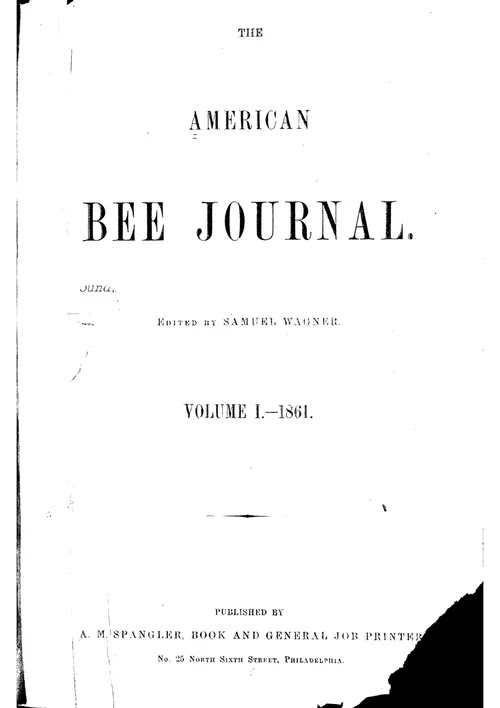
American Bee Journal Vol 01 1861 — American Bee Journal, 1861 This is the foundational text of the collection. It provides the baseline for American apicultural thought during the mid-19th century. It is essential for understanding the origins of the industry.
American Bee Journal Vol 02 1866 — American Bee Journal, 1866 This volume documents the post-war expansion of apiary practices. It is a critical record of early hive management and early scientific observations.
American Bee Journal Vol 03 1867 — American Bee Journal, 1867 A vital record of seasonal observations. It provides the longitudinal data necessary to track historical forage patterns.
American Bee Journal Vol 04 1868 — American Bee Journal, 1868 This volume focuses on the refinement of hive structures. It is a key text for understanding the evolution of equipment.
American Bee Journal Vol 05 1869 — American Bee Journal, 1869 A study in early pest management and colony health. It provides the historical context for modern disease control.
American Bee Journal Vol 06 1870 — American Bee Journal, 1870 This volume continues the chronological record of American bee-keeping. It is necessary for establishing long-term biological trends.
American Bee Journal Vol 07 1871 — American Bee Journal, 1871 A critical volume for studying the intersection of agriculture and apiculture. It documents the early economic importance of honey production.
American Bee Journal Vol 08 1872 — American Bee Journal, 1872 This volume provides detailed accounts of seasonal variations. It is essential for the advanced researcher.
American Bee Journal Vol 09 1873 — American Bee Journal, 1873 A record of early scientific inquiry into bee behavior. It serves as a primary source for behavioral studies.
American Bee Journal Vol 10 1874 — American Bee Journal, 1874 This volume documents the expansion of apiary technology. It is a cornerstone of the collection.
American Bee Journal Vol 11 1875 — American Bee Journal, 1875 A detailed account of colony health and management. It provides the necessary data for historical comparison.
American Bee Journal Vol 12 1876 — American Bee Journal, 1876 This volume completes the early foundational sequence. It is required for a complete understanding of 19th-century apiculture.
What This Collection Actually Covers
The American Bee Journal Books Collection is not a collection of "tips." It is a collection of historical and scientific records. It covers the evolution of apicultural science from the mid-19th century to the modern era.
Specifically, the collection addresses:
- The evolution of hive design and thermal regulation.
- Historical records of honeybee diseases and pest management.
- Longitudinal data on forage availability and seasonal shifts.
- The development of the American honeybee industry.
- The transition from anecdotal beekeeping to scientific apiculture.
Explore the full American Bee Journal Books Collection Collection to access the complete archive.
FAQ
Q: Why is an offline archive necessary for scientific study? Digital information is volatile. Websites are deleted. Servers go offline. A scientific study requires permanent, immutable data. An offline archive ensures that your knowledge base remains intact regardless of internet availability or platform stability.
Q: Can I use these books for modern beekeeping? Yes, but only if you understand the context. The books provide the historical data necessary to understand modern trends. You must distinguish between 19th-century methods and modern scientific consensus.
Q: How is the data organized? The collection is organized chronologically. This allows for a systematic study of how apicultural knowledge has evolved over time. This structure is mandatory for longitudinal research.
Q: Is this collection for beginners? Beginners should use the most recent volumes. Advanced practitioners should use the entire archive to conduct historical audits of biological trends.
Q: What is the difference between this and a textbook? A textbook is a synthesis of existing knowledge. This archive is a collection of primary sources. A textbook tells you what is known; this archive shows you how it was discovered.
Sources and Methodology
- Books identified via Google Books API cross-referenced against the OFFREADS offline archive
- Archive last updated: 2026-07-30
- Article reviewed by: The OFFREADS Curatorial Team
Historical and scientific reports detailing the background and implementation of American Bee Journal Books Collection protocols. https://americanbeejournal.com/
Historical and scientific reports detailing the background and implementation of American Bee Journal Books Collection protocols. https://americanbeejournal.com/history/
Related Reading
- Why you need the British Bee Journal Beekeepers Adviser Books Collection library
- Why you need the Scientific American Series Books Collection library
- Why you need the Scientific American Series Books Collection Complete Collection library
- Why you need the American History Books Collection library
External Authority & Further Reading
[!NOTE] To further expand your mastery of this subject, we highly recommend referencing the National Archives and established academic databases. True knowledge requires triangulating historical sources. Our offline collection acts as the foundational bedrock for this ongoing research.
Curator's Note: American Bee Journal Books Collection
The primary source texts discussed here are preserved in this collection. Secure the complete offline archive directly from our vault.
Premium Knowledge
American Bee Journal Books Collection
Curated collection of 521 authoritative volumes on American Bee Journal Books Collection.
Curator's Note: American Bee Journal Books Collection
The primary source texts discussed here are preserved in this collection. Secure the complete offline archive directly from our vault.
Further Reading
The American Bee Journal curated corpus integrates into adjacent subject categories within the broader OFFREADS library. Researchers working in this domain will find relevant cross-references in related collections available at offreads.com/collections. The vault spans 130,000+ volumes across history, science, law, philosophy, and technical fields — all delivered in the same format as this archive.
The Case for Physical Digital Archives
Sovereign digital assets — unencrypted, locally preserved, platform-agnostic — address a systematic vulnerability in subscription-based access models. The American Bee Journal archive demonstrates this at scale: hundreds of works in a single download folder, owned outright, with no recurring payment required to maintain access. The analogy to physical ownership is accurate: these files behave like books, not subscriptions.
Offline Sovereignty: The Case for Knowledge Independence
The American Bee Journal collection is structured for offline-first use. Once downloaded, the hundreds of volumes require zero remote server verification, zero recurring fees, and zero live network dependency. This is not merely a convenience feature — it is a resilience requirement. Internet access is intermittent, platforms shut down, and licensing agreements expire. A self-contained, indexed reference repository containing hundreds of works in this field is not replicated by any streaming service currently operating.
Preservation NetworkExplore Book List & PDF →Explore Book List & PDF →Explore Book List & PDF →
Related Historical Archives & PDF Collections
British Bee Journal & Beekeepers’ Adviser Books Collection
77Preserved Works (PDF & EPUB)
American History Books Collection
4242Preserved Works (PDF & EPUB)
Scientific American 19th-Century Magazine Archive
2750Preserved Works (PDF & EPUB)
Curatorial Network
Related Archival Analyses & Treatises
Share This Analysis
Subject Collection
The texts analyzed in this article are available in our curated collection.
Free Weekly Dispatch
New Archives. Every Week.
Get notified when we add new collections, free samples, and curator notes.
No spam. Unsubscribe anytime.